

The Journey Begins in 12th-Century Japan
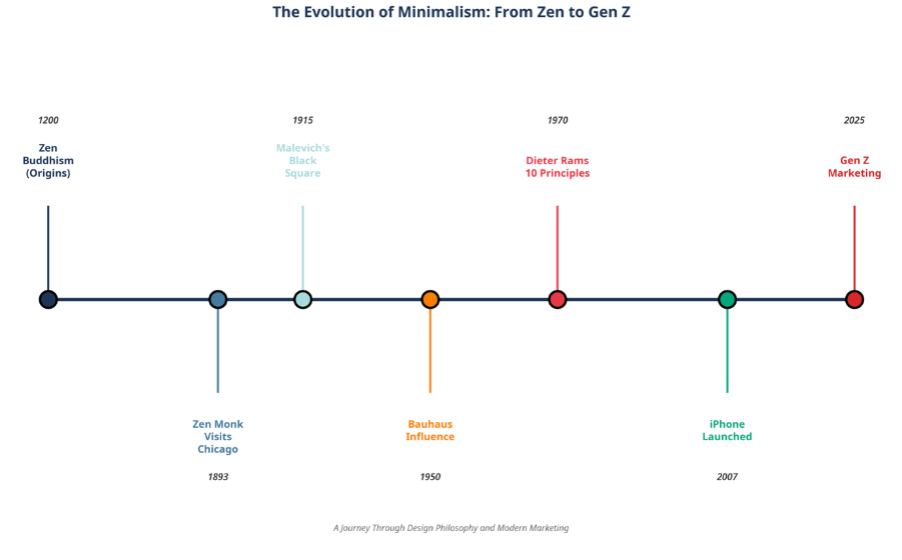
The story of modern minimalism doesn't start in New York or Berlin. It starts in 12th-century Japan, with Zen Buddhism. Zen aesthetics introduced a revolutionary concept: that true beauty lies in emptiness, in what's not there.
Zen design emphasized empty space, natural materials, and a deep appreciation for the unadorned. A single brushstroke. A bare room. The sound of silence. This wasn't minimalism as we know it today—it was a philosophical approach to existence itself.
The Bridge Between East and West
In 1893, a renowned Zen Buddhist monk visited the World Parliament of Religions in Chicago. This event sparked a growing fascination with Eastern philosophy among Western artists and designers. The concept began to shift from “less is more” to something more tangible: design stripped of ornamentation, reduced to its essential elements.
By the early 20th century, this philosophy had taken root in Western art. In 1915, Russian artist Kazimir Malevich unveiled his “Black Square on White Ground”—a radical geometric abstraction that rejected all decorative embellishment. It was minimalism’s formal arrival in the Western art world.
The Bauhaus Revolution
Around the same time, the Bauhaus school in Germany was revolutionizing design education. The movement championed an industrial, functional approach where form followed purpose and ornamentation was deemed superfluous. Ludwig Mies van der Rohe, the school’s last director, crystallized this philosophy with his famous aphorism: ”God is in the details.”
Mies understood that minimalism wasn’t about emptiness—it was about precision. Every element had to earn its place. His designs, from the Tugendhat House to the Toronto-Dominion Centre logo, exemplified this principle: seemingly simple elements combined to create understated elegance and profound functionality.
Dieter Rams and the Ten Principles
Fast forward to the 1970s. German industrial designer Dieter Rams, working with premium brand Braun, observed that the design world was becoming an “impenetrable confusion of forms, colours and noises.” His response? The “Ten Principles of Good Design”:
- Innovative
- Useful
- Aesthetic
- Understandable
- Unobtrusive
- Honest
- Long-lasting
- Thorough
- Environmentally friendly
- Minimal
These principles became a guiding light for product development and influenced designers for decades to come.
From Design Philosophy to Digital Reality
Here’s where it gets interesting: these principles, developed decades before the digital revolution, perfectly describe the design of the iPhone. Steve Jobs and his team at Apple didn’t invent minimalism—they applied century-old design principles to technology.
The iPhone’s clean interface, intuitive navigation, and focus on essential functions over feature bloat represent the culmination of a design philosophy that began in Zen temples and evolved through Bauhaus, Constructivism, and industrial design.

Why This History Matters Today
Understanding this lineage is crucial for marketers targeting Gen Z. The principles that guided Mies van der Rohe and Dieter Rams—authenticity, functionality, clarity, and respect for the user—are exactly what Gen Z values. They’re not responding to minimalism because it’s trendy. They’re responding because these principles address their deepest needs: clarity in a chaotic world, authenticity in an age of performance, and respect for their time and attention.